A Tow That Starts With Tension
Heavy trucks do not always break down in convenient places. Jackknifed semis, trucks on soft ground, and equipment shifted off trailers: none of these are straightforward towing calls. Our Arvada towing team handles situations like these regularly. The first step is almost always extraction, not transport.
Winching uses a powered cable to pull a vehicle out of a stuck position. Heavy loads call for extension lines and snatch blocks to redirect pulling force. Solid anchoring keeps the recovery truck stable. Rigging setup separates a clean extraction from a damaging one.
Before we move anything, we check the vehicle’s weight, position, cargo, and the condition of the ground. A loaded trailer on a slope may need a completely different setup than an empty tractor stuck in mud. Those details shape the rigging plan before the first line is connected.
Once the Vehicle Is Out, Heavy Towing Begins
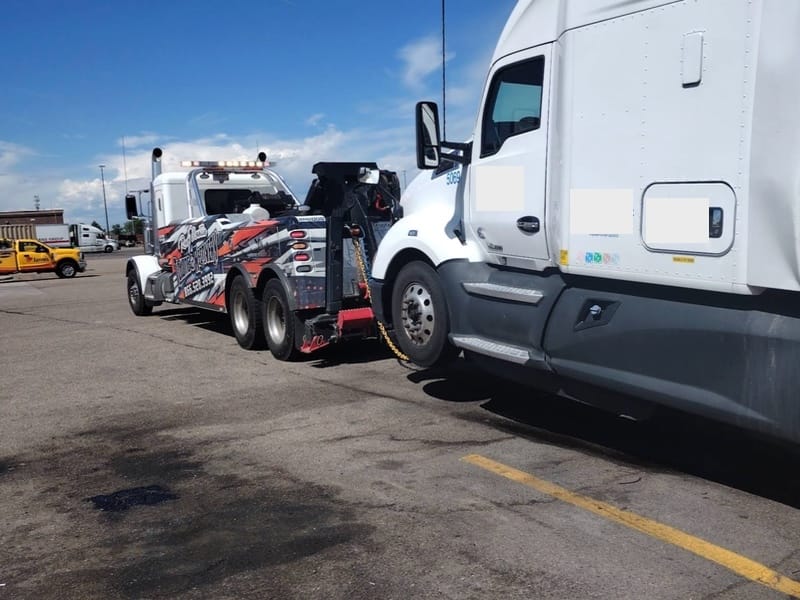
Heavy-duty towing uses rotators, heavy wreckers, and extended boom equipment for loads standard trucks cannot handle. Our fleet is built exclusively for this type of work. No light-duty calls. No standard passenger vehicles. Just heavy trucks, semis, and commercial loads.
Matching the right equipment to the situation matters before the truck leaves. A load shift on a running commercial truck is a different call than a rolled semi on a highway embankment. Our Arvada towing dispatchers confirm vehicle type, position, and road conditions before assigning a unit. The goal is the right truck arriving on the first trip.
What the Vehicle’s Position Determines About the Response
A vehicle upright on pavement and one that has gone down a highway embankment call for entirely different responses. The recovery sequence is set on arrival, not before. Arvada towing operators assess the position first and the rig second. If extraction is needed, it comes before any transport work begins.
Heavy-Duty Calls: Winching vs Towing at a Glance
Here is how the two typically break down on commercial calls:
- Winching: vehicle is off the road, on soft terrain, or in a position blocking a direct approach
- Heavy winching: jackknifed semis, rolled trucks, and vehicles that have left major corridor shoulders
- Towing after extraction: once on accessible ground, heavy wreckers or rotators handle transport
- Straight heavy tow: vehicle is on pavement, accessible, and ready to load without extraction
- Load shift correction: cargo must be repositioned before the vehicle can be safely moved
- Every Arvada towing call is assessed on arrival for extraction need before the rigging plan is set
Rocky Mountain Towing & Recovery: Arvada Towing Built for Heavy-Duty Work Only
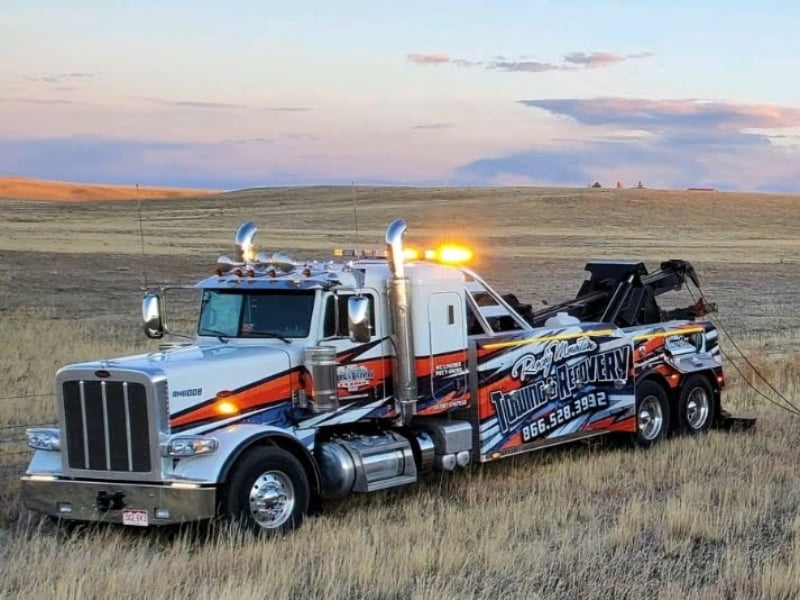
We are a heavy-duty towing specialist based next to I-76 in the Denver metro area. Our in-house dispatch team is available for immediate response, and our Arvada towing coverage serves commercial operators and fleet managers who need experienced heavy-duty crews. Our location gives us direct access to one of the region’s busiest commercial routes. We regularly respond to loaded semis, disabled tractors, shifted cargo, and trucks stuck beyond the shoulder.
From load shift corrections to complex highway recoveries, we send the right equipment and an experienced operator to every Arvada towing call. Heavy towing is the only work we do, and every dispatch reflects that focus. We keep our fleet and crew prepared for jobs where vehicle weight, road position, and cargo condition can change the recovery plan.
FAQ
What makes heavy-duty towing different from standard towing?
Heavy-duty towing involves loads that exceed the capacity of light and medium-duty equipment. It requires rotators, heavy wreckers, and operators trained in commercial vehicle recovery. The rigging approach, load calculations, and scene management all differ from what a standard flatbed or wheel-lift handles.
What is a rotator tow truck and what is its role in heavy recovery?
A rotator is a heavy-duty recovery truck with a boom that pivots a full 360 degrees. We use it when we cannot approach a vehicle from a straight angle. We also use it when it has rolled or gone off an embankment, or when surrounding obstacles prevent standard wrecker alignment. The rotating boom allows the operator to apply force from almost any position around the stuck vehicle.
What is a load shift and how do towing operators handle it?
A load shift happens when cargo inside a trailer moves during transit, changing the vehicle’s weight distribution. This can make a truck unsafe to drive or cause it to lean or tip. Operators must assess the load, reposition or secure the cargo before moving the vehicle, and confirm stability before transport. In some cases, the cargo has to be partially offloaded first.
What does diesel roadside assistance cover on a highway call?
Diesel roadside assistance handles breakdowns that can be resolved on-site without towing. That includes tire changes on commercial trucks, battery jump-starts, fuel delivery, and minor mechanical issues that do not require a shop. For commercial operators, a roadside fix avoids the cost and downtime of a full tow, getting the driver back on the road faster when the situation allows.
What certifications do heavy-duty tow operators typically hold?
WreckMaster certification is the most recognized standard in the towing industry, with advanced levels covering heavy recovery, rigging calculations, and complex vehicle positioning. Traffic Incident Management training is increasingly required for operators who work highway rotations. Operators handling commercial cargo may also hold certifications specific to load securement and hazardous materials, depending on the type of freight they encounter.